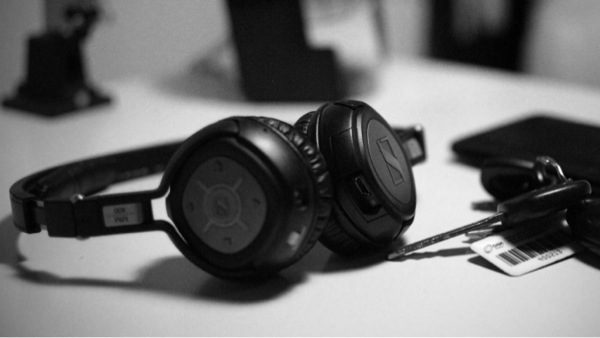
Those who know me will know I’m a very avid consumer of sounds. I’m always listening to something in my headphones, off in my own world. Therefore it shouldn’t be a surprise to anyone that I take headphones pretty seriously. Not crazy-audiophile-serious, but I have had many different pairs and have spent my fair share of money on them. I thought I’d share some thoughts about my current pair.
My current pair are the Sennheiser MM400s. Here’s a link to the since-updated model. I think they would be categorised as closed back supra-aural headphones, which means they sit on your ears, and they don’t leak too much sound into the environment around you. Their main feature is the fact they are Bluetooth enabled, which means I don’t have to plug in to listen to my iPhone or any other Bluetooth-enabled device I might be using.
I think I first came across these headphones was in the Apple Store some years ago. At the time, they were priced around $400. Bluetooth headphones were just starting to become good enough for listening to music rather than just for making calls. I remember putting them on and wondering who would pay that much for a pair of headphones. I paid $240 for my pair just under a year ago. It was a little luxury purchase after I got my new job.
My previous daily headphones before that was a set of in-ears, Etymotic ER6is (also discontinued). They sounded amazing, but were not very durable. The cord always got tangled up because the cable was so thin, which meant when I wanted to listen to something I had to spend time untying knots of cable, which was extremely frustrating, especially if you just wanted to listen to something short. They were great at blocking out external noise because they sat in your ear and sealed off the outside world. Some people don’t like these types of earphones because they find them uncomfortable. I undertand that, but they didn’t bother me too much. When the cord gave way, I decided it was time to go all in on Bluetooth.
This wasn’t my first pair of Bluetooth phones. I had a set of Sony DR-BT–101s. I bought a refurbished pair of those for $50 or something, just for walking around the house, where I do a lot of listening to podcasts. They were a bit too daggy and big to wear on the train, but they sounded pretty good, so they were a nice compromise. I sold them when I bought the Sennheisers.
The MM400s sound terrific, full stop. You could probably say they sound amazing considering the small size of the phones and the fact they are wireless. Comfort-wise, the are quite good. They get a little bit irritating after a few hours of sitting in one place on your head, but you just adjust them and you’re fine. Battery life is great, maybe ten hours listening. I charge them most nights, but I could probably afford to charge them maybe every second night. They have an adaptor for plugging into the audio systems of planes and when a device doesn’t have Bluetooth, like older iPods. Not only that, but it contains power plugs for the US, Australia and Europe and a small case to put it all in. They are truly travel ready.
The real test of headphones is how they fit into your life. You can have the nicest set of cans going around but if they are too big and bulky to wear out, you’ll end up leaving them at home when you commute. Here are a few situations where the MM400s work best for me.
On my commute, they are indispensible. I use them for the iPhone and iPad for listening to music and podcasts, and for watching video. You can skip tracks and change volumes with the buttons on the right earphone. With my podcast client, Downcast, I can use the track skip buttons to go back if I missed something or fast-forward if I’ve heard something before. I put them on before I get out of my car and sometimes jhave them on until after I’ve sat down in my office. That works out to be about three hours a day. They make my long commute tolerable, even enjoyable.
They also function insanely well in the gym and for running. They fit snugly enough that they don’t move at all, except when I’m doing some exercises where I’m not fully upright upright, like crunches. Gravity gets the better of them in those situations. For common exercise situations like the treadmill, bike, at the barbell rack or on the machines, they are terrific. No wires means the iPhone sits next to me on the floor and I just concentrate on what I’m doing.
If I get a call and the phone is in my pocket, the music stops, the ringtone comes through the headphones and I just press the play/pause button on the right headphone to pick up. The microphone built into the phones then takes over and I can talk normally to the person on the other end. When the call is over, the music comes back on without touching anything. It’s brilliant. The microphone is a little sensitive, as it probably needs to be to pick up the wearer’s voice. This means that noisy trains and streets become a little difficult for the person on the other end of the call. Still, it is a perfectly servicable input that does the job fine in most situations. There’s another cool button too, it’s white and on the bottom of the right phone that for a while I never used. I accidentally pressed it one day and bam, the Siri sound came through my headphones. The button triggered the old iOS ‘Voice Control’ feature on pre-Siri iPhones, but now with one tap you can issue commands to your phone hands-free. I’ve found Siri a little unreliable at the best of times and the mic certainly doesn’t help matters so it probably would be more useful in a quiet house when you aren’t embasrrassed to talk out loud to yourself in the street. It’s not really a reason to buy these phones but it’s a nice bonus if you have the current iPhone.
I’ve found that the way that iOS handles Bluetooth can be annoying when you want to switch between devices. For example if I want to go from listening to a podcast on my phone to a video on the iPad, I have to turn Bluetooth off on the phone, switch it on on the iPad then press connect, which can take fifteen seconds or so. This is because the headphones automatically pair with the last device they were connected to, which is awesome if you use the same device most of the time but can be fidgety if you do it often. It’s something to keep in mind, but I think this trade off is pretty well made. Most of the time I use these headphones with the iPhone.
Another thing to consider is these types of headphones tend to let a bit of outside noise in. They don’t seal the ears like circumaural headphones or the in-ear types, which means that they may need to be turned up a bit louder in noiser environments, which isn’t ideal for longer listening sessions. You can choose to buy the next model up, the MM450s, which have noise canceling circuitry which should essentially eliminate this problem. They are substantially more expensive though, almost double the price in fact. One day I might be tempted to splurge on them, but I don’t think it’s worth the money for most people.
These headphones are really the fourth most likely thing that I will take with me when I leave the house. Obviously my phone, keys and wallet are the holy trinity, but the Sennheisers are always the next thing to take if I’m going to be out of the house for a bit longer. They fold up small enough to squeeze into a pocket in your jeans, which means you don’t necessarily need to be taking a bag of any sort to have them with you like you would if you had bigger headphones. I feel like I say this about every new set of headphones I buy, but these truly are the best headphones I’ve ever owned. I feel like it does a lot of the important things extremely well and the less important things well enough. Obvously, sound quality is important, and they sound great. The Bluetooth capabilities on them are fantastic. They travel extremely well. They look tidy and pack up small. They integrate really well with my devices. They aren’t perfect, but no headphones are - almost all require compromises to be made in some areas in order to do one particular job well. The compromises that have been made here very rarely affect my common use cases, and I’d say that is a sign that Sennheiser thought about this product a lot and made great engineering and design decisions. Headphones are very personal, and understanding which things you are prepared to compromise on generally gives you an insight into what you need to look for.
I don’t see that many people on the train using Bluetooth or cordless headphones, and I think that’s a shame. Maybe most people just think the buds that come with their phones are good enough and they probably are. But I feel that most people would love to not have to worry about cables when it comes to their phones or iPods. I find wireless listening very unencumbering, liberating almost. I hate using wired phones when I’m outside the house now. There’s no going back for me, I don’t think.